Athlete Hive
My first experience as a product manager leading a team through a three month product ideation competition.
.png)
September - December 2024
Overview
Timeline
3 months
Product Manager
Role
Type
Product competition
Project Context
Description
Athlete Hive is a platform that helps student-athletes in mid-major sports connect with local businesses for NIL opportunities. It gives overlooked athletes a chance to monetize their brand and helps businesses market through authentic campus partnerships.
Goal
-
Help athletes outside major revenue sports land NIL deals.
-
Connect local businesses with athlete influencers.
Problem Statement
Mid-size student-athletes at major universities often struggle to find NIL deals. A marketplace connecting them with local businesses would create new NIL opportunities for these athletes while helping businesses leverage university talent for advertising.
Product Analysis
Work
User Personas
Our user personas include mid-size UM student-athletes and Ann Arbor business owners—two groups that are ideal matches but struggle to connect. Athletes have strong personal brands but limited visibility, while business owners lack the resources to find NIL partners or brand ambassadors. Our research and interviews helped us understand their challenges and build Athlete Hive as a marketplace designed to bridge that gap.
I conducted a detailed, frame-by-frame audit of the onboarding flow, content creation process, chatbot, and settings interface—identifying layout issues, design flaws, bugs, and usability roadblocks throughout.

Competitor Analysis
While platforms like MOGL and 98 Strong connect athletes with brand opportunities, they lack integrated tools for managing social media profiles, and cater to a nationwide audience. Including integrated social media management tools will allow athletes to streamline their online presence and track engagement. Additionally, launching first in Ann Arbor provides a target-demographic saturated environment to really understand how our product behaves in the market.


Market Research
Our go-to-market strategy is to launch first in Ann Arbor to validate our concept locally. Our total addressable market is 100% of college student-athletes nationwide, while our serviceable obtainable market focuses on mid-size student-athletes using our platform at the University of Michigan.
Wireframes
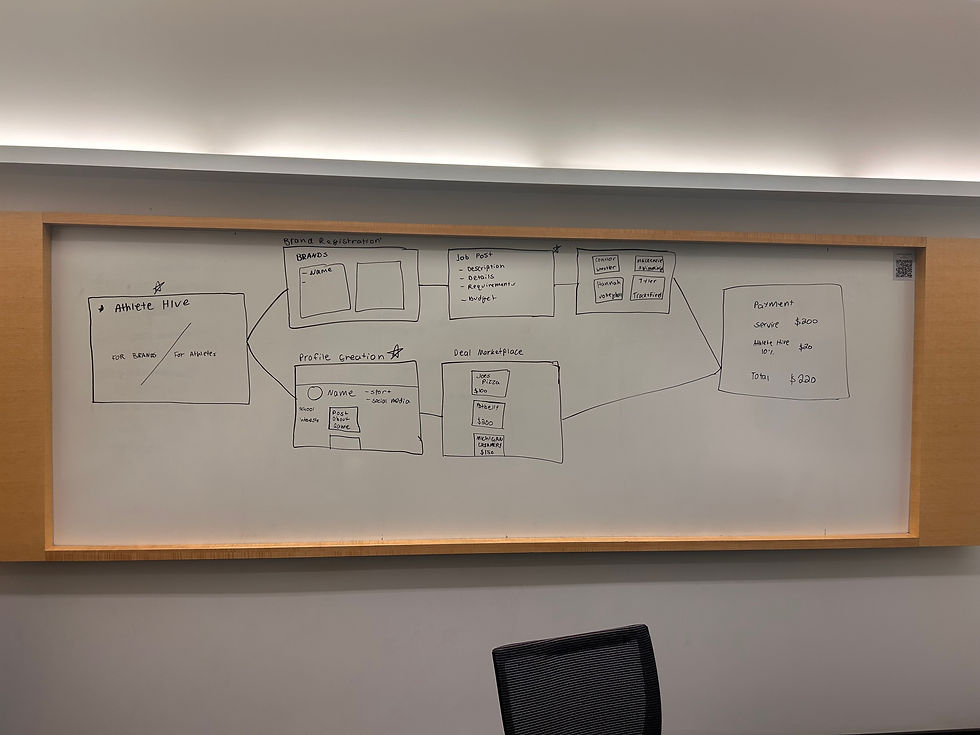
We began the design process by brainstorming and sketching wireframes together on a whiteboard, focusing on user flow and key features. Our designer, Sherrie, then transformed these initial concepts into detailed, interactive Figma prototypes, refining the user experience while incorporating team feedback throughout.

Business Side Flow

Athlete Side Flow
Reflection
Process Shapes Product
The structure of this competition pushed us to go beyond surface-level thinking. Weekly assignments like user personas, market research, and interviews were not just checkboxes, they made us think critically about our users and the market we were entering. This step-by-step approach helped us build Athlete Hive on a solid foundation, and by the end, we had a product that felt thoughtful, validated, and grounded in real needs.
Clarity Unlocks Speed
Once our team aligned on a clear product vision of empowering mid-sized student athletes to monetize their brands through local business partnerships, design decisions, copy, and research all became faster and more focused. It was a reminder that when everyone understands the reason behind the work, you do not need constant feedback loops to stay on track.
Leading Through Ambiguity
As the product manager, I learned how important it is to lead with both structure and flexibility. Early on, our direction was still forming, and it was on me to keep momentum while the vision evolved. Balancing open ended exploration with clear next steps helped our team stay motivated and aligned. It showed me that good leadership is not about having all the answers, it is about helping the team find them together.